Brown trout (Salmo trutta) is a highly sought game species, while also considered as patrimonial in many countries and regions over its whole distribution area, Eurasia. It is also a species, consequently, that has a strong interaction with humans : through fishing over many millennia, but also through translocation, and very intensive stocking since 150 years. Meanwhile, geneticists have shown that the species harbours wondrous levels of genetic diversity that have been shaped over hundred of thousands years. Five distinct lineages have at least been identified, among which the Atlantic (ATL) and Mediterranean (MED) lineages, occupying roughly the Atlantic side and Mediterranean side of Europa, roughly.

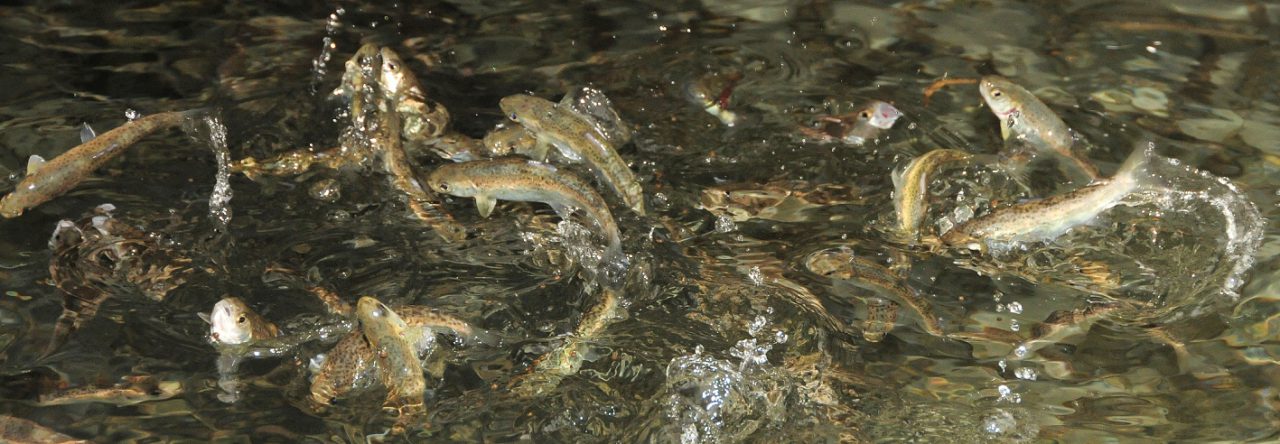
Pictures of brown trout originating from two different lineages. The Atlantic lineage (ATL) is characterized by large spots (orange arrow) and the presence of a visible lateral line (green arrow). The Mediterranean lineage (MED) displays a very large quantity of small black spots, a few vertical black stripes (black arrows), but no visible lateral line.
Worldwide efforts of introduction or restocking in the initial distribution area however was done mostly using the ATL lineage. The most striking consequence was the massive creation of hybrids and the introgression of ATL genes into local native lineages, well described by geneticists. Biodiversity managers have consequently attempted different strategies to protect the MED lineage, and possibly remove ATL genes. One such strategy that was partially successful is the translocation of native MED fish into areas where ATL genes are dominant. Partially only, because, if the proportion of ATL genes declined, the proportion of hybrids (HYB) increased.
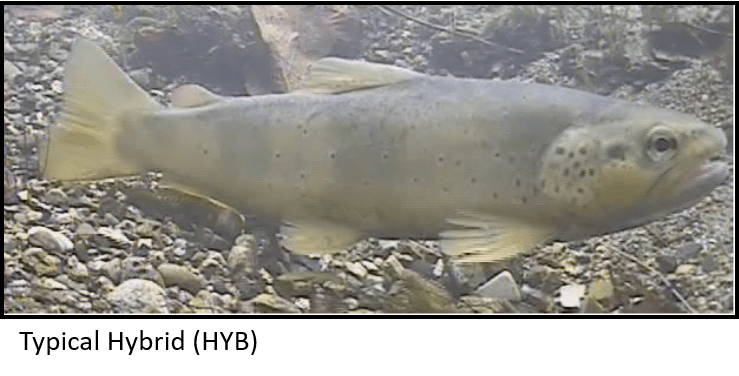
Picture of a hybrid brown trout. The vertical stripes are roughly visible as in a MED trout, but the number of spots relates more to an ATL trout.
More recently however, we uncovered behavioural and selective mechanisms involved in the fitness of hybrids. More specifically, it appears that offspring of MED females survive much better in cold waters than those of ATL females: this is evidence for a temperature based genotype / environment interaction. And temperature fluctuates temporally, but also spatially. Could such an eco-evolutionary mechanism be involved significantly in the maintenance of hybrid genotypes ?

The relation between offspring, survival, temperature and maternal introgression. Offspring from MED females fare better in cold waters.
To answer this question, we built a simulation demogenetic model, wherein we replicated the actions of the biodiversity managers, accounting (or not) for the genotype / environment described above. Basically, we simulated the translocation of MED individuals from the downstream part of a river to the upstream part, previously stocked with ATL fish.
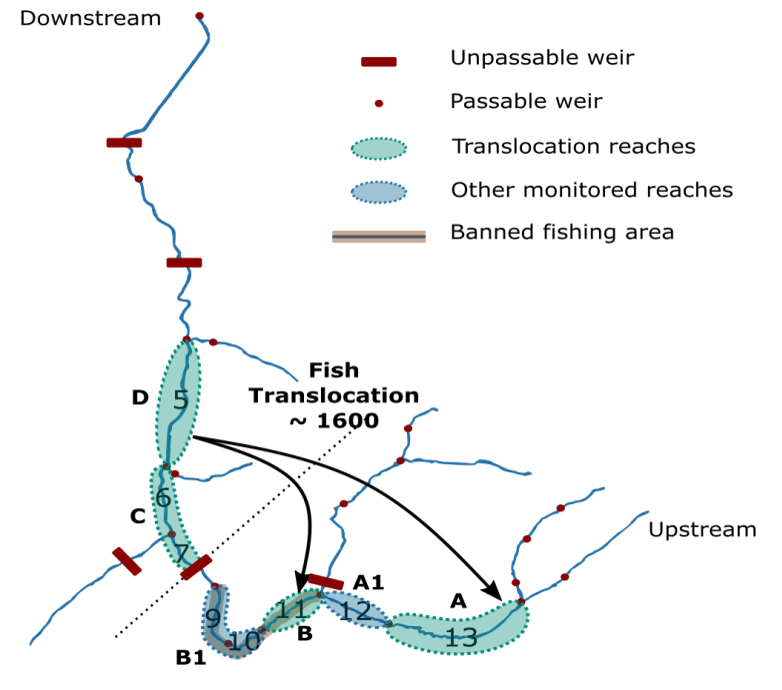
Simulation scenario, based on the actual translocation protocol : in 2005, a rather large number of MED fish was caught downstream and released in the upstream area, where only ATL fish were present. The biodiversity managers then tracked introgression for several years afterwards.
The model proposed two trajectories, depending on the inclusion of the genotype / environment interaction. Without this interaction (neutral scenario), introgression in the upstream area barely declined. But with the interaction, the introgression declined quickly in 2 generations. Yet meanwhile, a very large number of hybrids were created.
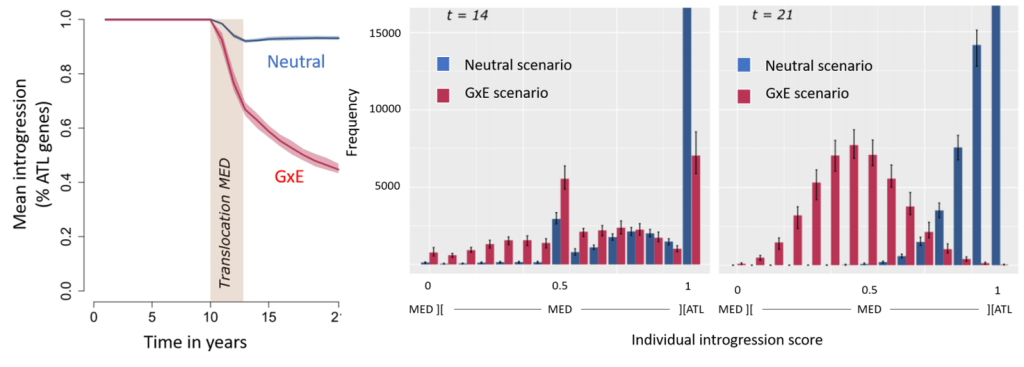
The cool thing is, the neutral scenario was very far from reality (introgression data provided by biodiversity managers), whereas the genotype / environment scenario was much closer, indicating that this eco-evolutionary mechanism is rather likely to be responsible for a large part of the observed dynamics of introgression.
Take-home message : eco-evolution is clearly interacting with our management practices, possibly on very short time scales, and with massive effects.
References of interest :
Dorinda Folio, Arnaud Caudron, Laure Vigier, Sylvie Oddou-Muratorio, Jacques Labonne. Using eco‐evolutionary models to improve management of introgression in brown trout. Ecology of Freshwater Fish, 2024, ⟨10.1111/eff.12789⟩. ⟨hal-04603141⟩
Dorinda Folio, Jordi Gil, Arnaud Caudron, Jacques Labonne. Genotype‐by‐environment interactions drive the maintenance of genetic variation in a Salmo trutta L. hybrid zone. Evolutionary Applications, 2021, 14, pp.2698-2711. ⟨10.1111/eva.13307⟩. ⟨hal-03420466⟩
Jordi Gil, Jacques Labonne, A. Caudron. Evaluation of strategies to conserve and restore intraspecific biodiversity of brown trout: outcomes from genetic monitoring in the French Alps. Reviews in Fish Biology and Fisheries, 2016, 26 (1), pp.1-11. ⟨10.1007/s11160-015-9405-y⟩. ⟨hal-01901371⟩
Amaia Lamarins, Victor Fririon, Dorinda Marie Folio, Camille Vernier, Léa Daupagne, et al.. Importance of interindividual interactions in eco‐evolutionary population dynamics: The rise of demo‐genetic agent‐based models. Evolutionary Applications, 2022, 15 (12), pp.1988-2001. ⟨10.1111/eva.13508⟩. ⟨hal-03909303⟩
 ECOBIOP