Predicting evolution requires understanding interactions between individuals: it is all about context.

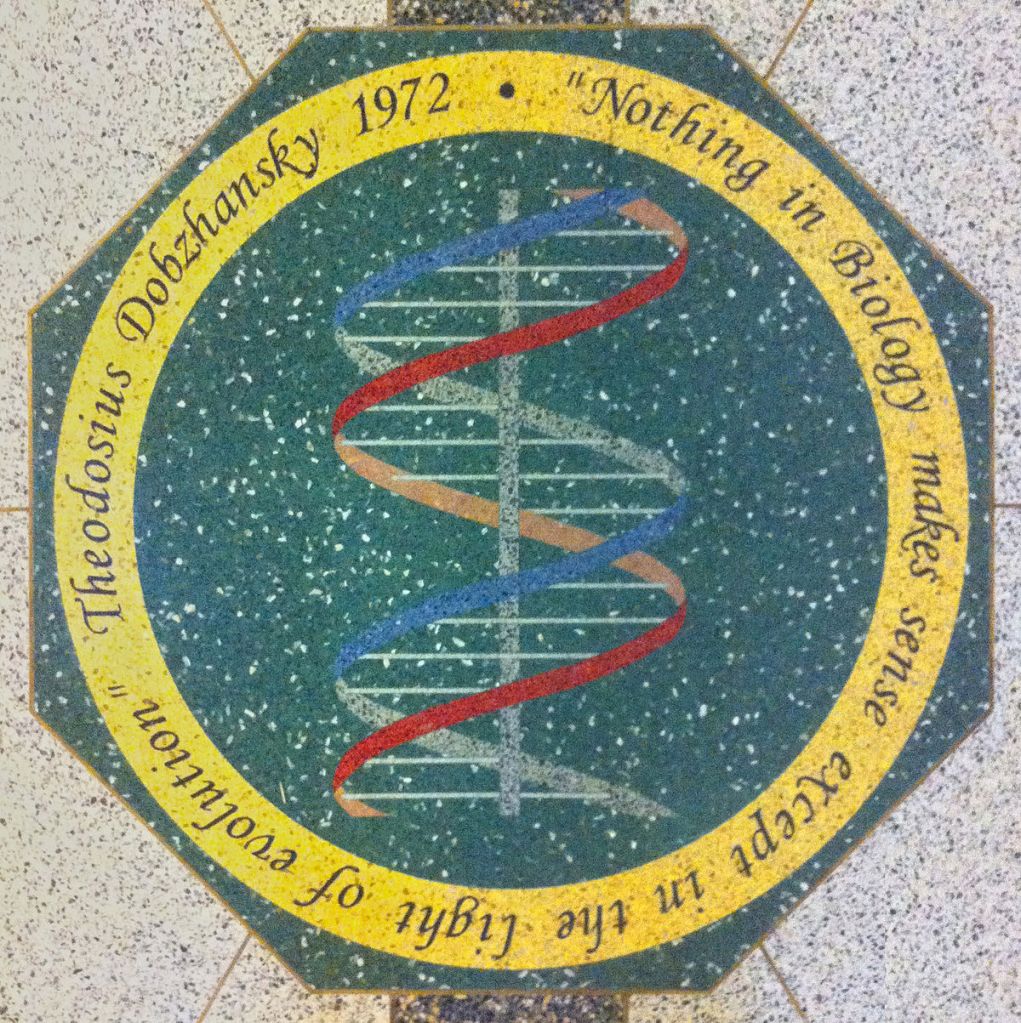
The modern synthetic theory of evolution is often referred as to one of the most successful scientific theories. This is so, because in a handful of principles, mechanisms, it seems to have the power to explain many different things in our environment. Macro-evolution, paleontology, artificial selection, heredity, etc. It ripples in many biological sciences, possibly bringing some « light » to make sense of what surrounds us, as coined by Dobzhansky. To the researcher however, nothing looks very obvious in this theory, or we would not still be trying to test all its premises and predict all its consequences.

This theory mainly deals with the interacting effects of four forces: mutation, genetic drift, gene flow, and selection. The interplay of these forces has yet to be fully explored, understood, assimilated. We’re still far from that. The last one, selection, is the founding principle behind Darwin’s thinking of course. It mainly describes the inequality between individuals in terms of genetic contribution to the next generation. The shape, the strength, the speed of selection are of major interest, because they are expected to be seminal to local adaptation and divergence between gene pools located in different environments. But all these mathematical descriptors of selection hide a simple truth: selection emerges from interaction between individuals within a given environment.
Interaction between individuals is one of the hardest things to predict in science. This is so because individual decisions are made all the time depending on informations: internal and external informations, both possibly changing at a rapid pace. Indeed, other individuals decide too, react to their internal state and their direct environment. And this environment is changing dynamically. In a nutshell, it is mostly about local context.

On the one hand, one can decide to exactly look at this context, and its conditional choices. As an example, Game Theory has been specifically developed to this intent, and therefore provides us with a rational expectation of what individuals should do when facing a decision, with total or partial information. This approach embraced by Maynard-Smith however, as several others, is burdened (but also empowered) by optimality assumptions, that are consubstantial to behavioural ecology: individuals, at evolutionary equilibrium, should choose what is best for them, because if they do not, then it is not an equilibrium: they will reduce their fitness. What is unclear is whether actual evolution will reach such equilibrium: yes selection is here, but remember about mutation, drift, gene flow ? As many hurdles on the path to equilibrium.
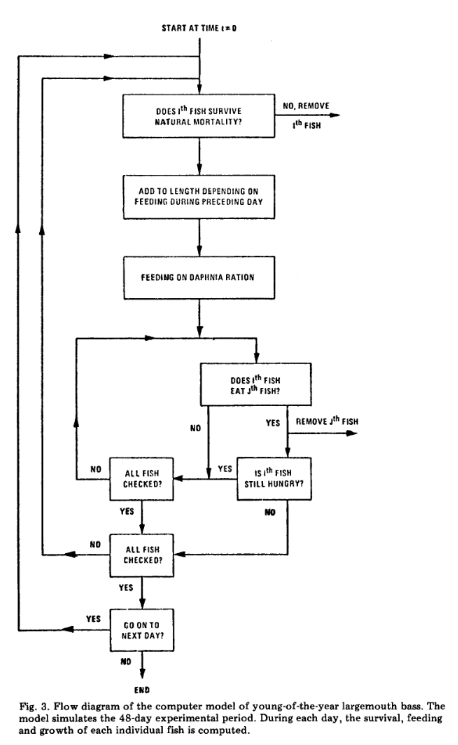
On the other hand however, one can actually decide to let the play unroll, and observe the result. For instance, De Angelis et al., in 1980, could not fathom why from initially similar experimental conditions, very qualitatively different patterns could be obtained, for instance, the emergence or the lack of cannibalism in fish tanks. Turning his attention to the interactions between individuals, he realized that their outcome could be very contrasted, and therefore did not lead to a single equilibrium, but to several, fundamentally, qualitatively, and ecologically different. Such an outcome would likely not be obtained using game theory for instance. This observation was seminal to the development of agent based modelling, where the focus is directed to the algorithmics of interactions between agents, and the resulting and emerging patterns (see the Figure extracted from de Angelis et al., 1980).

Being ecologists, being geneticists, eco-physiologists, behaviouralists or demographers, we realize that we produce knowledge pertaining to natural selection, but we always do so in a specific context. And yet, we are tempted to derive general rules from our results, whereas we usually have a feeble grasp of the interactions between individuals in our experiments. Either because it was not the focus of the experiment, or because we could not produce many different and replicated experimental situations. One way however to explore the field of possible outcomes is to turn to dynamic modelling, involving both the 4 driving forces of evolution, and the individual interactions that give rise to them.

Being ecologists, being geneticists, eco-physiologists, behaviouralists or demographers, some of us have already turned to this solution, and it is proving to be enlightening. In particular, it rapidly reshapes what we thought to be the main drivers of evolution, the speed at which they can operate, and how much selection is context dependent. Some of us also felt the need to give a name to this approach, so to identify scientific studies that integrate the required ingredients to study eco-evolutionary loops in a realistic framework: DemoGenetic Agent Based Models, or DG-ABMs.

I have been quite lengthy already, so if you want to know more about this new generation of eco-evolutionary models, you can either check out the summary figure below, or have a look at our last paper on the matter.

Reference cited:

DeAngelis DL, Cox DK, Coutant CC. 1980. Cannibalism and size dispersal in young-of-the-year largemouth bass: experiment and model. Ecological Modelling. 8:133–48
Body size evolution during a metapopulation expansion

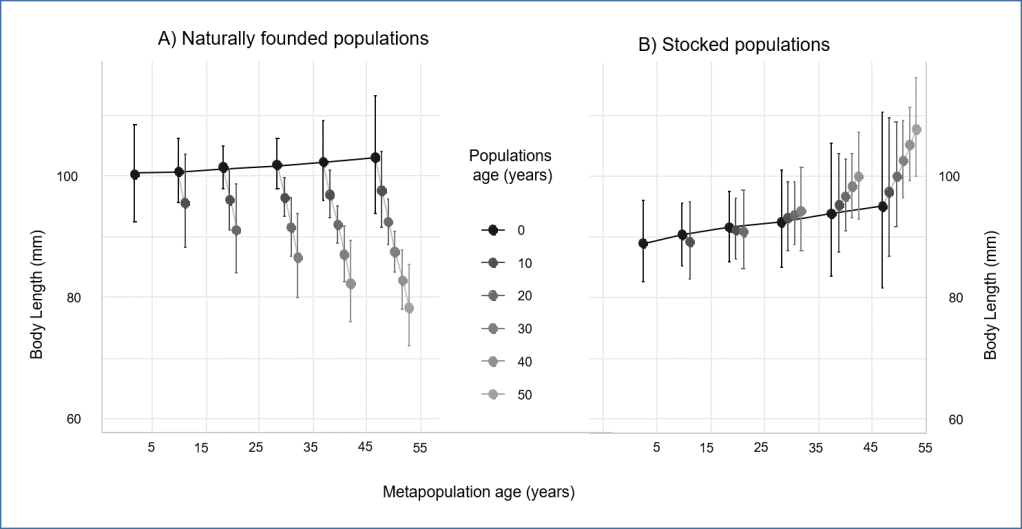
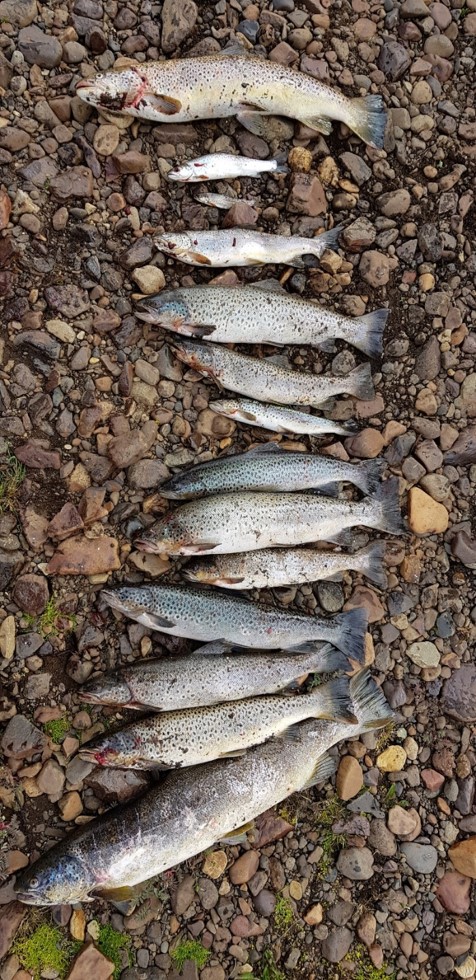
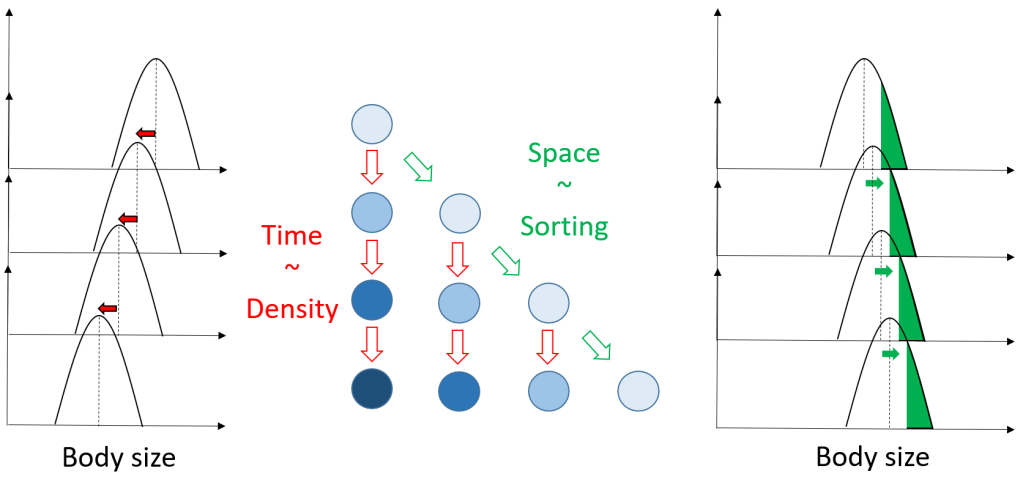
Animals and plants come in a wondrous variation of size. This variation is obvious among species, but it can also be tremendous within species. Fish are a shiny example, like in salmonids, where for a given age, some fish can be twice as long as others, and much heavier. Growth is very plastic in fish, and it does explain a large part of this variation in correlation with trophic resource and local density, that drive competition for resource. Such process can be particularly well observed in recent metapopulations: as time passes, core populations tend to become more populated, increasing local competition over resource. As a consequence, body size at age should decrease over time (red arrows in the figure below).

But there are other mechanisms that may drive the evolution of growth, and therefore body size at age. As the metapopulation itself expands, new boundaries populations are created by dispersing individuals, and these individuals may not be a random sample of their source population. If they are presenting higher body size at age than the population mean for example, then we could observe a gradient along the expansion front where body size at age would continuously evolve toward higher values (green arrows).

This spatial sorting is expected because body size at age is often partly heritable, so these dispersers present genetic characteristics that will drive the foundation of the new population, provided the subsequent gene flow with core populations is not too strong.

We turned to the invasion of Kerguelen islands by introduced brown trout to investigate theses hypotheses. We managed to squeeze our database to obtain more than 21000 captures of one year old trout, along with their body size and day of capture, distributed over 42 populations spanning 50 years of monitoring. And we looked at how body size changed in each of these populations over time, depending on their foundation dates.

What we found was both reassuring and surprising. In fact, in naturally founded populations, body size evolved the way we expected: it increased along the expanding front (black curve, left panel on the figure above), yet at a reduced pace. In brown trout, migrating (and therefore potentially dispersing) individuals are usually the ones growing faster, so increased body size in newly founded populations makes sense. When populations got more crowded however, body size decreased quickly probably under the effect of competition for resource (greyish curves, left panel).

When we looked at populations introduced by human (right panel), the story was way different. First, body size on average was much smaller. Second, it was also a bit higher in recent populations compared to ancient ones, but this could not be due to spatial sorting (since no dispersers founded these populations). Finally, we did not find evidence for decreased body size in old populations where density should be higher. There are a number of possibilities to explain all these differences, but in a nutshell: even in remote areas such as subantarctic Kerguelen Islands, the footprints of human presence on evolution is staggering.

You may find more details in our recent publication on the matter, part of Lucie Aulus’s PhD:

https://doi.org/10.1098/rsbl.2021.0366

I’m picky.

Observations of reproductive behaviors in sexually reproducing organisms indicate that many species can be “choosy”: they tend to be selective for their partners quality. Mate choice has costs and potential benefits that are likely to vary depending on individual characteristics (e.g. sex, quality), and on social context (number of potential partners). And if you are too picky, that cost may have dire consequences: you will end up alone.

The dilemma of finding a mate in a fluctuating world, and the outcomes of being more or less choosy. It is a very old question, since sex appeared more than a billion years ago on Earth. Considering however the amount of internet bandwidth devoted to dating interactions, it will probably remain a central matter for centuries to come.

Classically, scientific literature predicts that the limiting sex (in term of gametes) – females – should be choosy, whereas the common sex – males – less so or not at all, or in very peculiar situations. Indeed, as a result of anisogamy (unbalance between gametes number and/or size between sexes), female’s reproductive rate is lower than males, making ready to mate males more numerous than ready to mate females and thus generating stronger mating competition among males. But who is really ready to mate, with which partner with regard to quality, and for how long? This is what can be described as the mating market, and it is everything but stable. Who can afford to be choosy in these conditions: males, females , or both? Individuals of high and low quality alike?

Louise Chevalier and her colleagues investigated this question using a dynamic game theory model: they assumed that all these individual choices affect the dynamics of pairings constantly, and allowed all individuals, whatever their quality or sex, to permanently readjust their choosiness, based on the balance between costs and benefits.

Their conclusions is that in fact, somewhat contrarily to what is known as the conventional sex roles wherein males compete to access the choosy females, choosiness should often evolve in both sexes, even when females are more rare than males. The results also imply that choosiness should adapt to the mating market, by being flexible over time, and can differ between individuals of different quality.

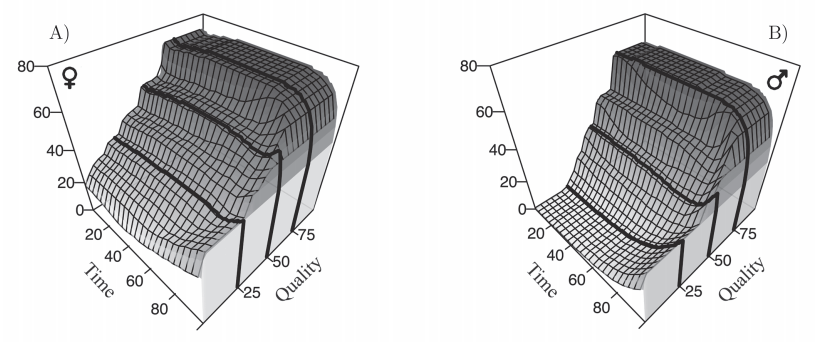
A view of optimal choosiness: on the left females, on the right, males. Choosiness, here on the Z-axis, expresses the quality of a potential partner above which one will probably accept to mate. Choosiness changes as the breeding season progresses (Time), but also as a function of of the chooser’s quality.

For instance, the figure above shows that choosiness differs between sexes, but almost every individuals here can be at least a bit choosy, even when their quality is poor: mutual mate choice in this example has evolved. We can also see that the choosiness is changing along time so to adapt to the dynamics of mating market. And if we look close enough, we might notice that choosiness does not increase linearly with quality: the population is in fact made of some sorts of subgroups, within which individuals have comparable fitnesses. This is an emerging property of the mating market: you might be in competition with everyone, but to various degrees. In fact, depending on the characteristics of the mating systems (latency period before returning to the mating pool, adult sex ratio), a wide range of choosiness evolution pattern is possible: you can explore these further using a Shiny Application here.

All these results and analyses can be found in The American Naturalist, and the model code is available here.